A Month of Sundays
07 September – 31 October
Artist
About the exhibition
A Month of Sundays,

or an extremely long time. Hyperbole is called for, since we no longer know exactly how long it has been, or because the minutes seem to be passing at an unbearably slow pace. It’s Sunday, we’re staying at home – maybe it’s raining. We stare vaguely at objects on the corner of the table, in a kind of absent-mindedness. Because we’re a little bored, because we’re thinking about Monday (Sunday blues). As we stare, we become detached and abstract; detached from the flow of things, and things – objects, a pear, a knife, a bouquet of irises and a cup of tea – from their context. As we abstract them, we look at objects for what they are, and they become singular and almost strange.
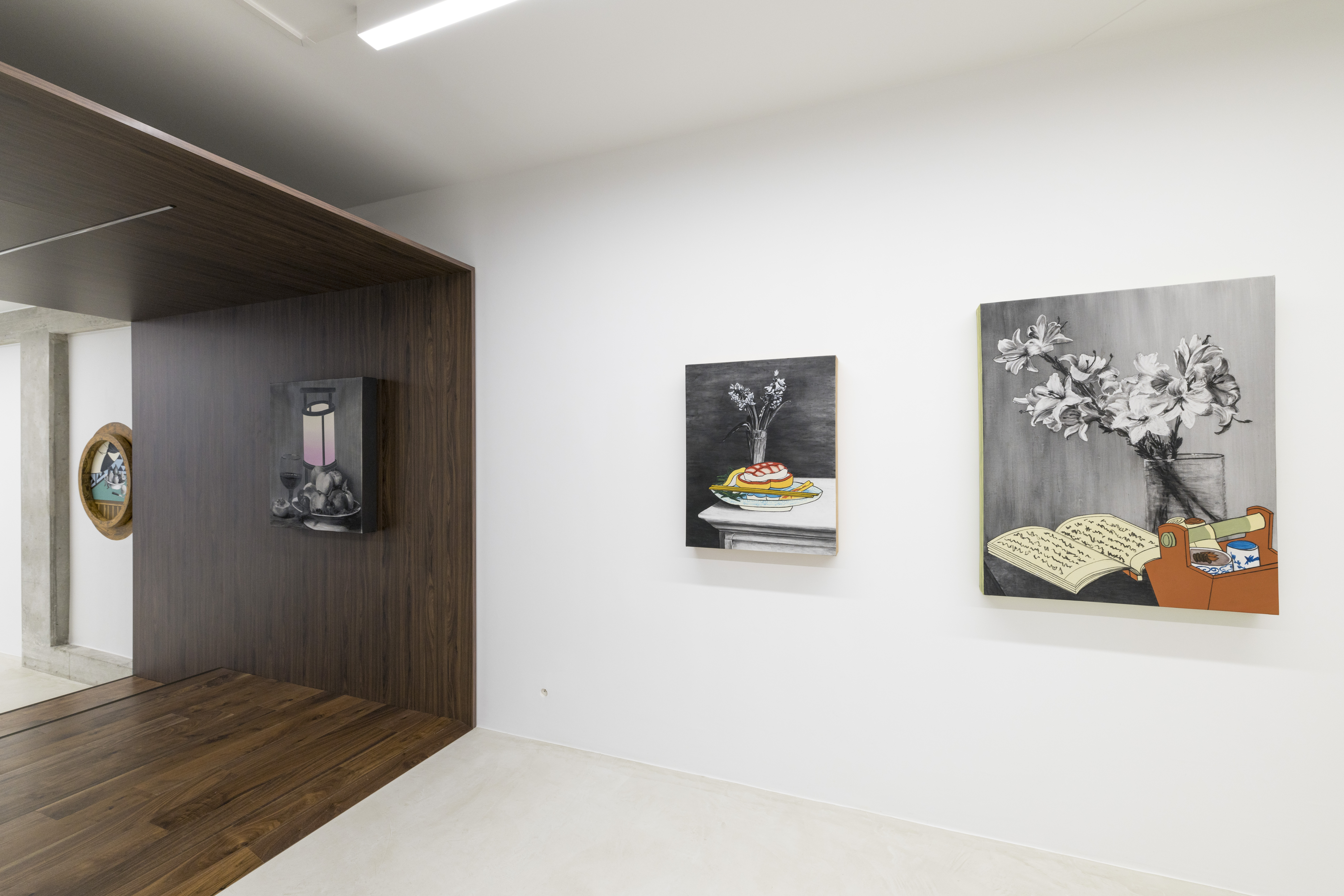
Bryce Delplanque paints still lifes. In Dutch, stilleven, meaning instant, frozen image. The bouquet of lilies, freshly picked by Henri Fantin-Latour , is suspended in its superb beauty for eternity. Suspended, therefore detached. According to some historians of the genre, still life may have originated from this detachment: objects considered minor in relation to the rest of the scene, details without characters or narratives, isolated from the rest of the painting. «Proceeding by detachment, still life would thus be a fall from painting.»
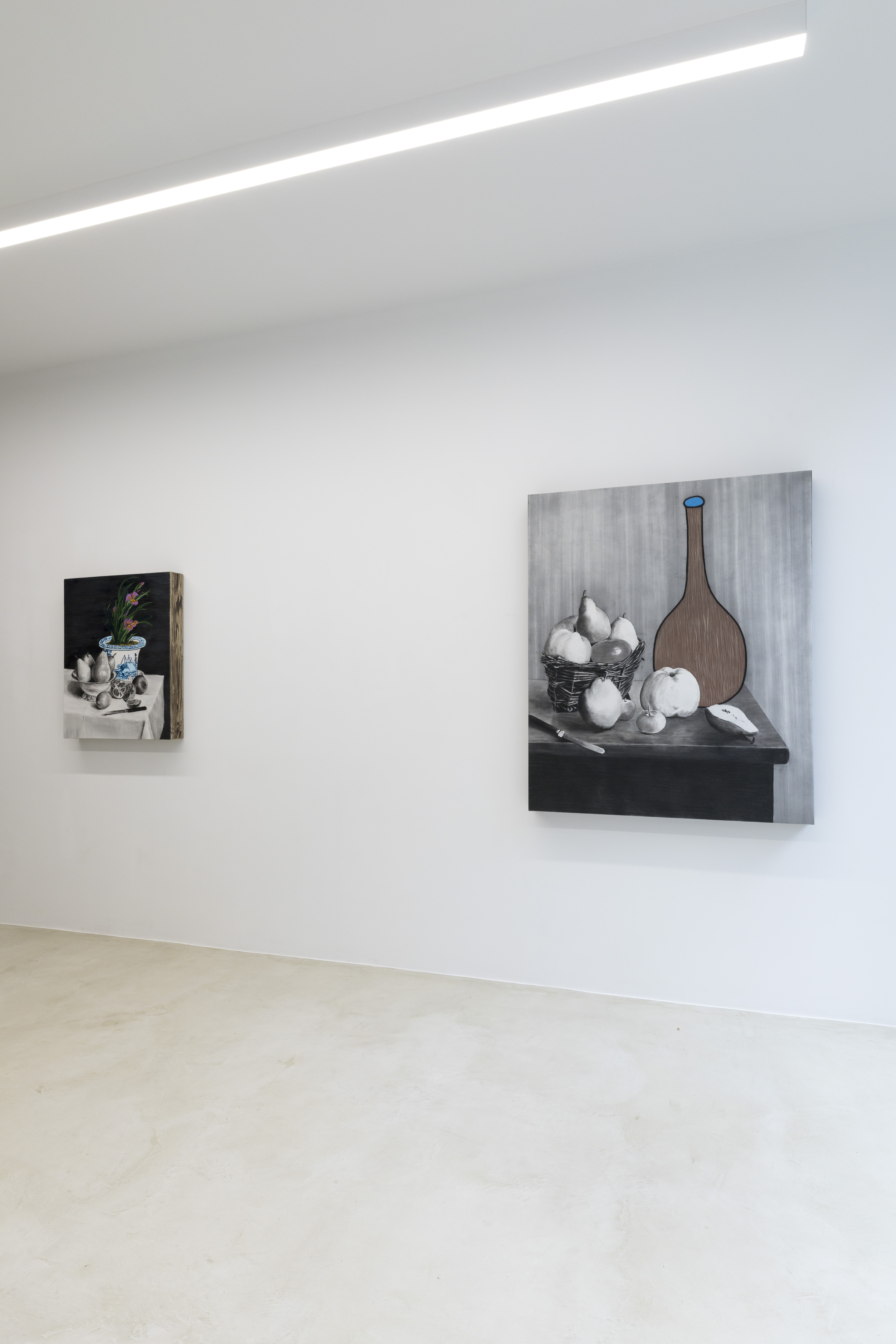
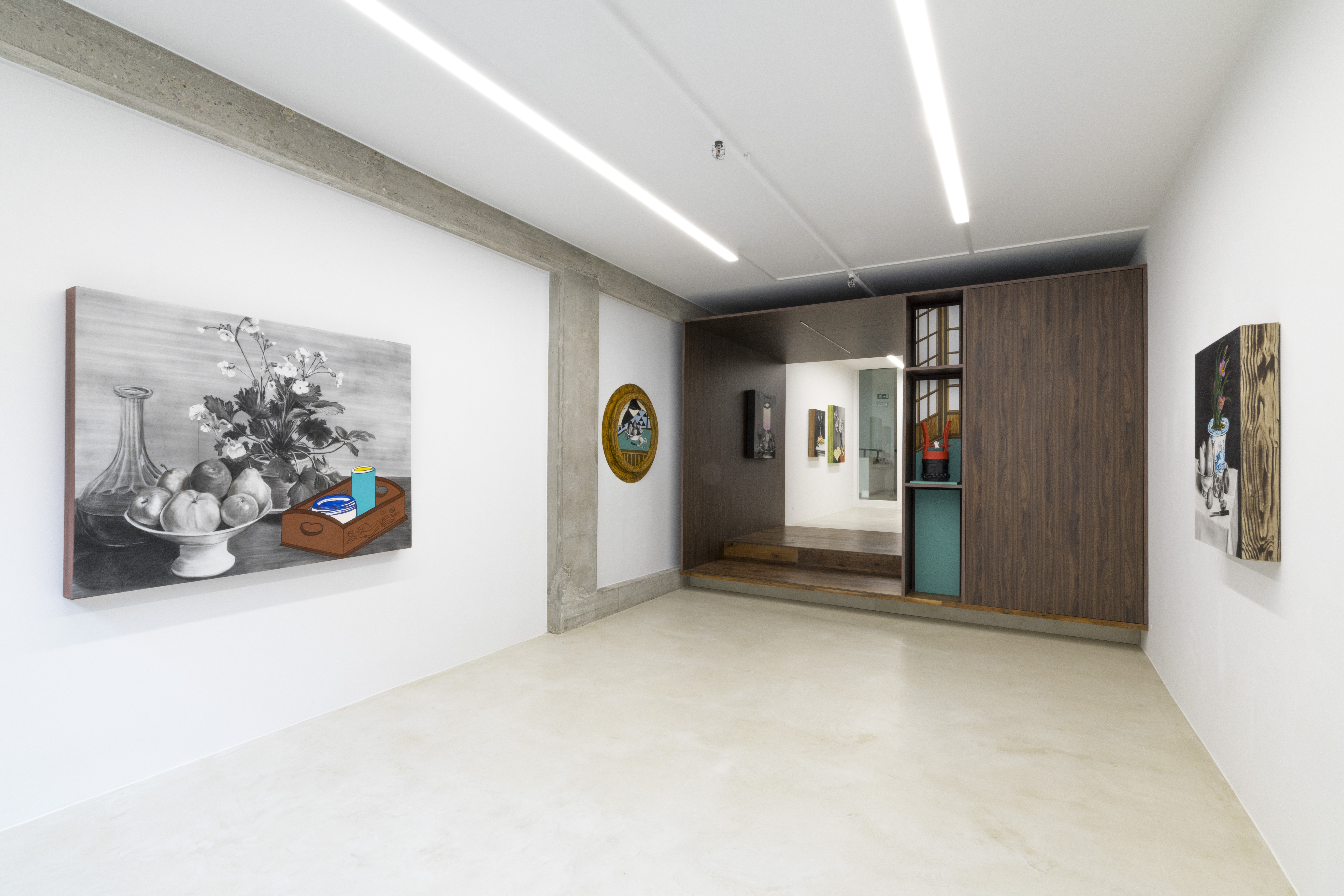
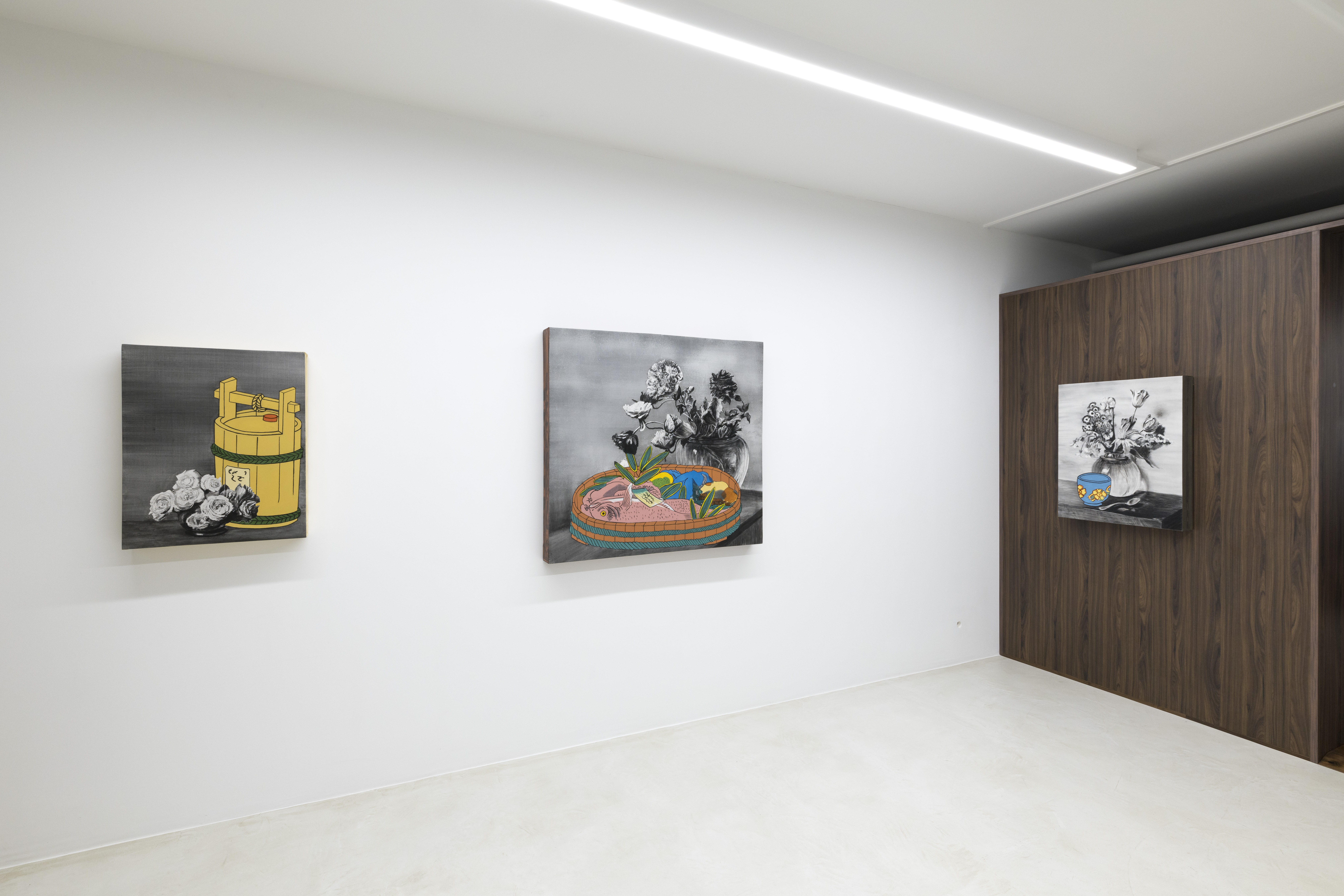
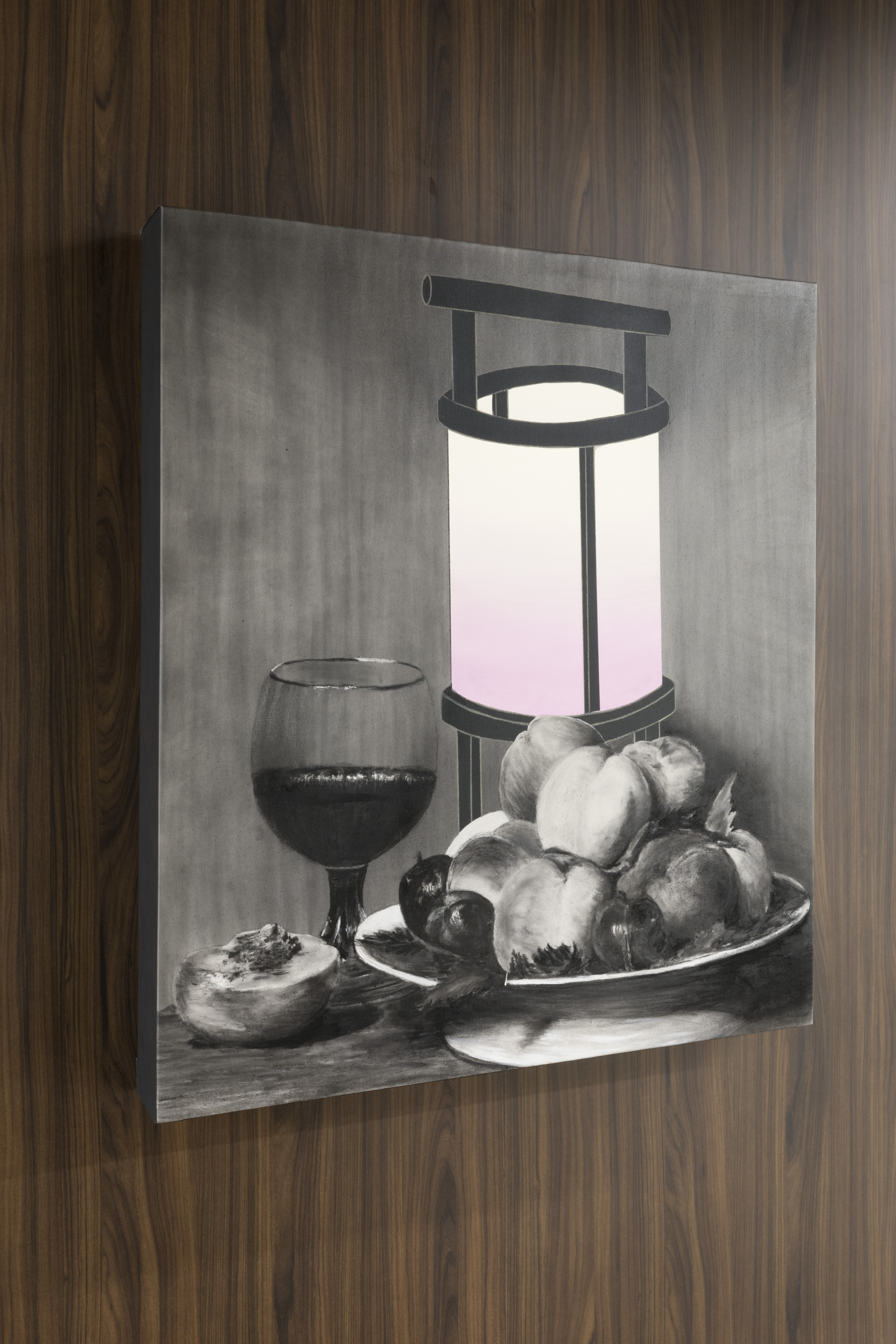
In Pear to Pear, Brandy, the knife has not yet fallen. We can sense it, on the edge of a piece of furniture, ready to slip. And suddenly everything begins to float. Through subtle chiaroscuro in charcoal, the pears stand out from the powdery background. And like a nose in the middle of a face, the brandy decanter, whose graphic and pictorial treatment clearly breaks with the whole. Borrowed (detached) from a print by Utagawa Kuniyoshi , it appears in colour, front-on and flat, defying the authoritarian Western perspective. The objects deny gravity and the representation denies distance – between France and Japan, the nineteenth century and the Edo period.
It is impossible to distinguish cause from effect, but the painting itself – whether subject or object, we will return to this – also enters a state of suspension. Bryce Delplanque paints after Fantin-Latour and Kuniyoshi, but above all after (and after) printed and digitised reproductions of their work. In this way, he paints images that are multiple, serial and flattened. He often receives Fantin’s images in black and white. In Kuniyoshi’s work, he is sensitive to the flat areas of colour that are approximately aligned with th .
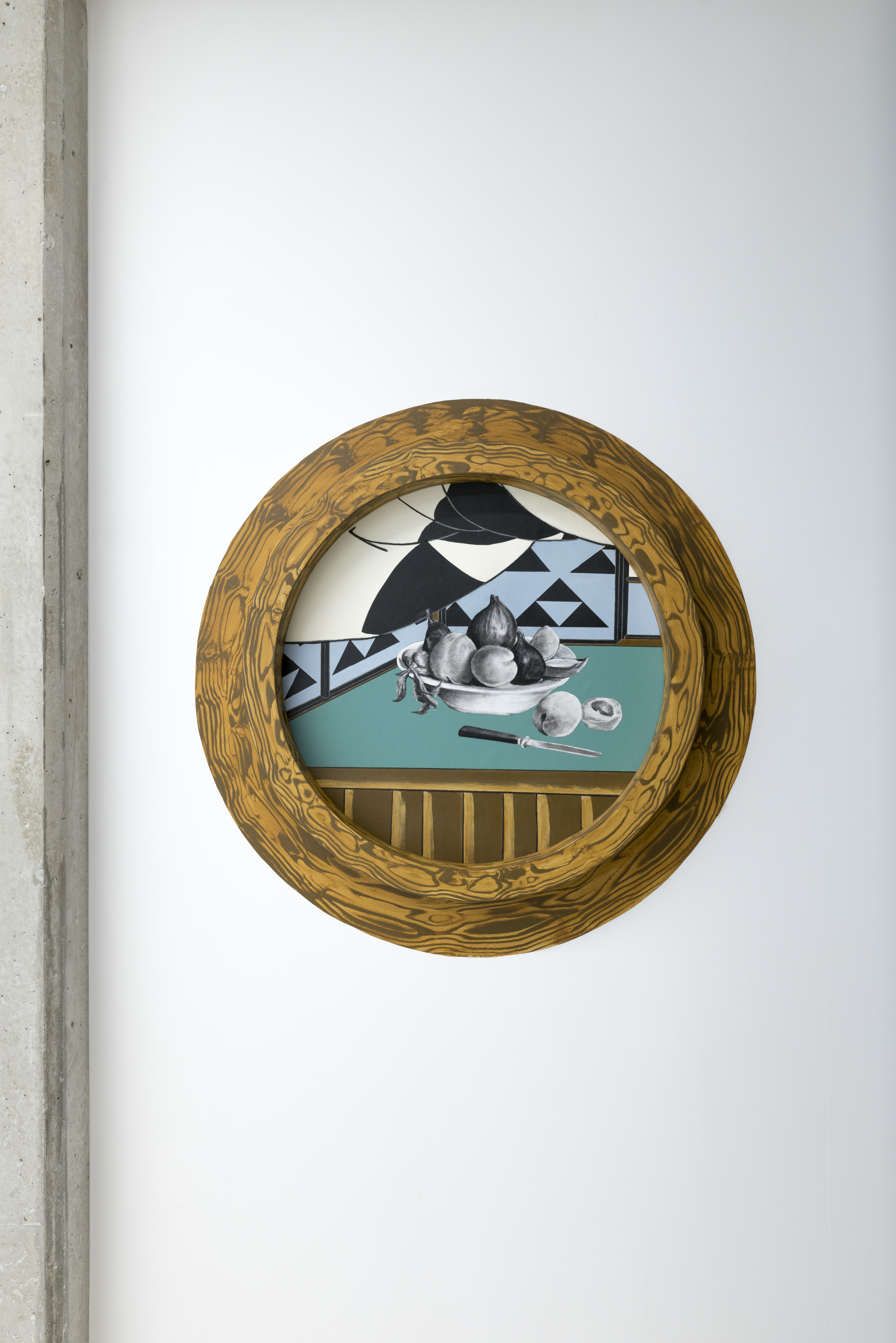
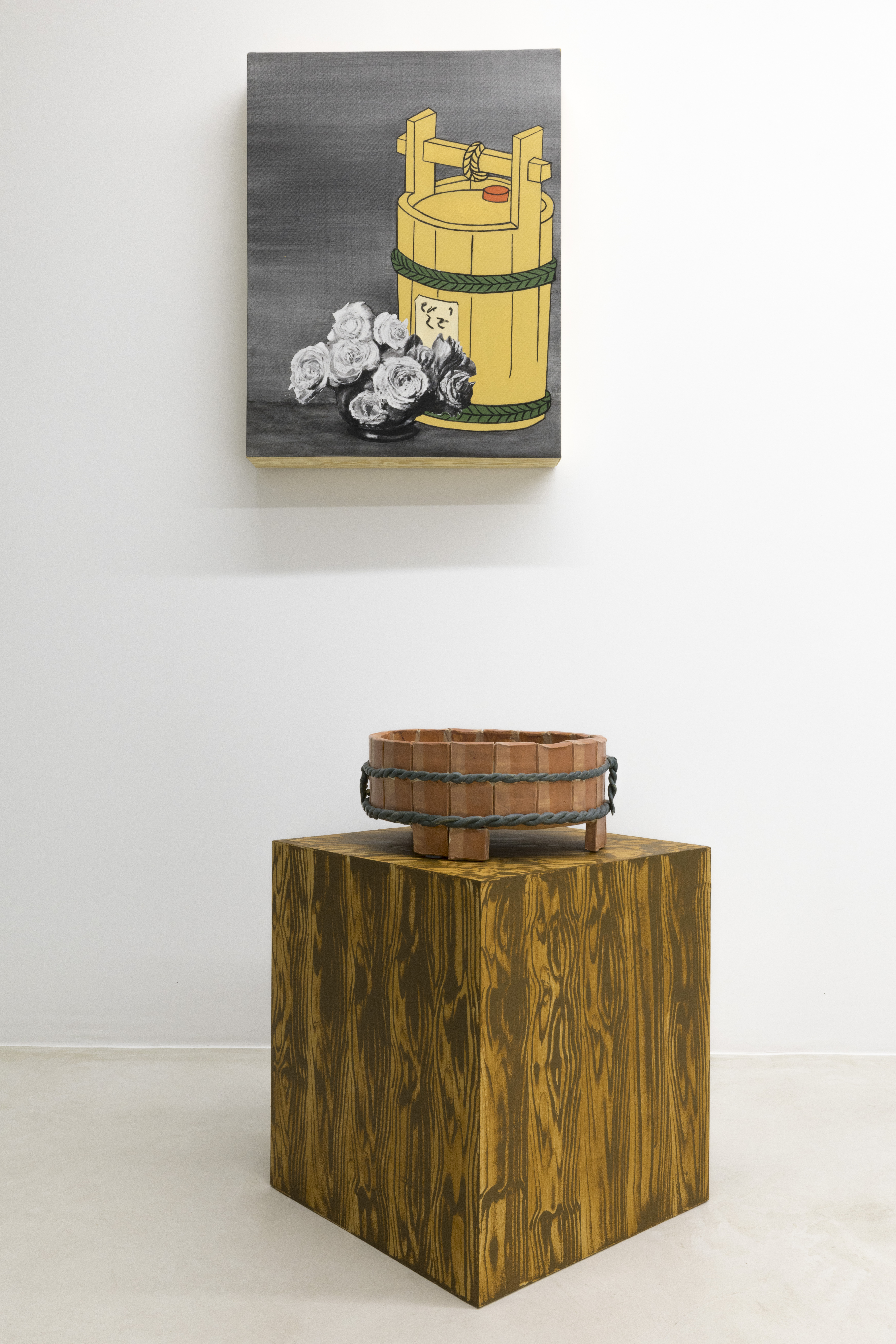
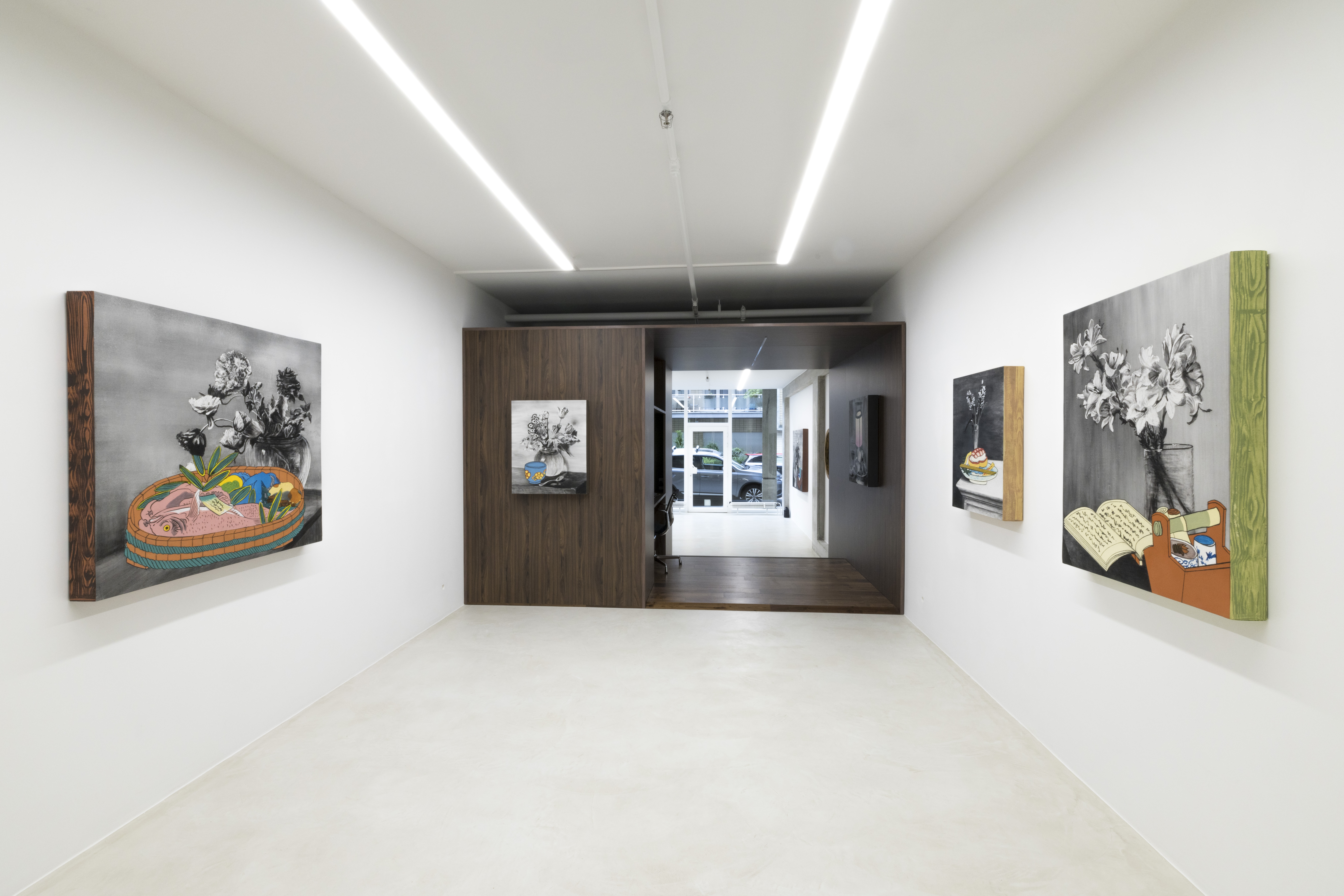
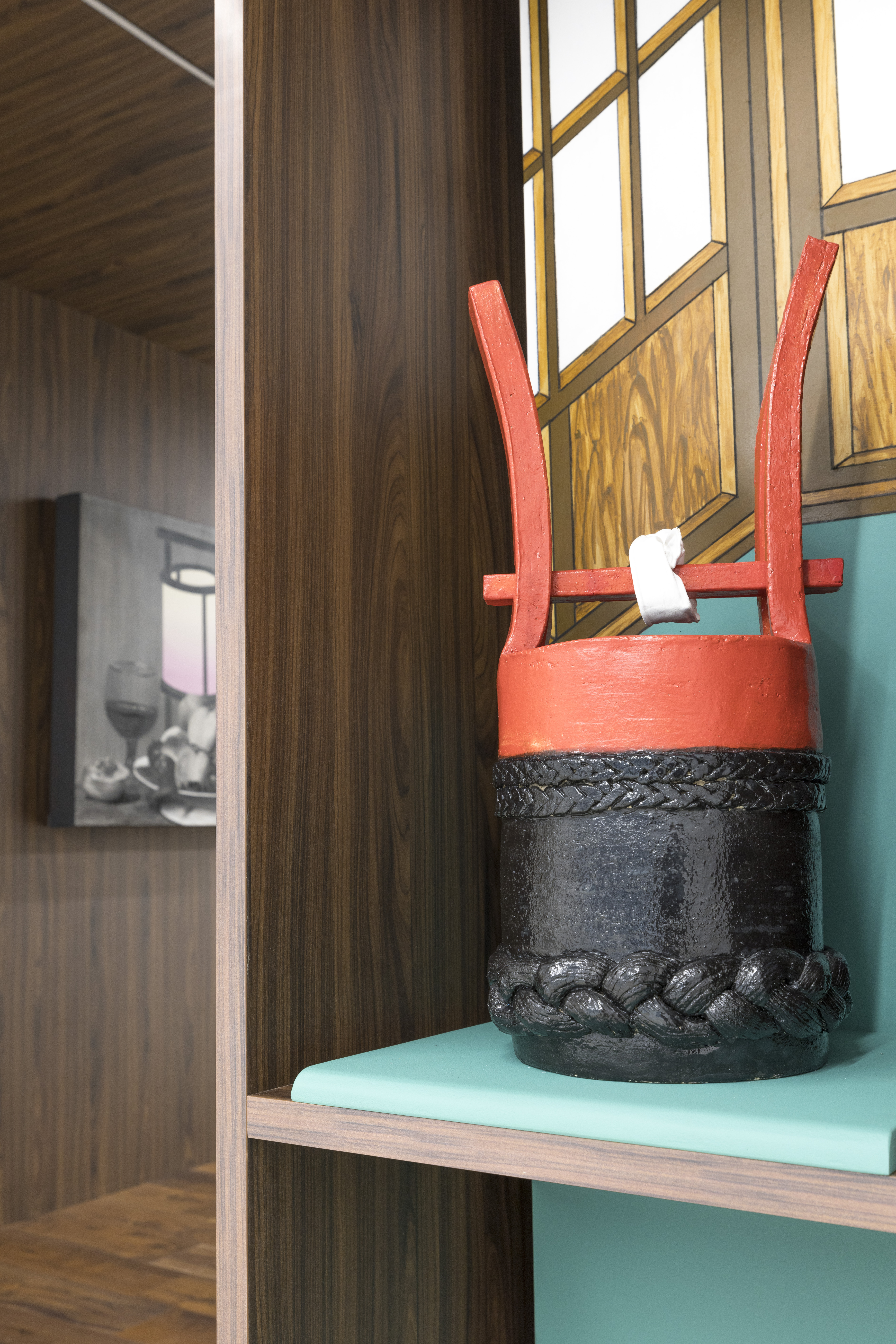
The encounter between these two aesthetic and cultural registers – systematic in this series – results in a form of distortion of painting and its status. Already, Fantin becomes charcoal, painting becomes drawing. At its heart, the perspectival confusion generated by the collage makes the composition all the more graphic (we are not far from flat design ). To further confuse the viewer, the painting seems to float on the surface of the canvas. Indeed, the edges of Bryce Delplanque’s paintings are exaggeratedly wide, as if extruded from the wall, to restore a perspective that has been too disrupted in the representation. The painting becomes volume, through an edge that itself forms an image. Treated as a trompe l’oeil with a faux wood comb, it effectively reduces the painting to its status as a simulacrum and an object.
By dint of looking, we no longer know what we are looking at. Let’s refocus on what we might call a minor detail in the history of (Western) painting. Throughout its history, still life has struggled to gain respect: painting of base objects, without merit, even representing what was considered the most «anti-pictorial» for the ancient Greeks. For the latter, the mediocrity of the subject was viral, and it was as if it contaminated the painting that depicted it. Once we move beyond the Albertian conception of art, which elevates even the lowest object to the status of a treasure, we can be more pragmatic and «draw [...] a curious property from still life. Namely, that regardless of its origin, a painting that depicts objects possesses the properties of what it shows, so that a painting that depicts objects is itself an object (whereas a landscape painting is obviously not a landscape).»
While this meta twist sheds light on Bryce Delplanque’s well-informed practice, another equally essential aspect must be clarified. The objects he paints (meaning both the subjects painted and the paintings themselves) are first and foremost objects of desire and pleasure. Food, fine drinks and fragrant flowers are synonymous with enjoyment. And even when the artist does not identify one of them precisely – because it is too distant or unfamiliar – it is because he loves them that he paints (or repaints) them. He loves the bright, contrasting colours and dynamic compositions of Kuniyoshi’s prints as much as the precision of the atmosphere, lighting and materials in Fantin-Latour’s still lifes. There is no postmodernist distance here, just visual and sensory pleasure – tactile pleasure. The silky texture of charcoal, the dense acrylic washes and, finally, the edges that detach the painting from the wall bring the pictorial cosa mentale closer to us, in a movement of intimacy.
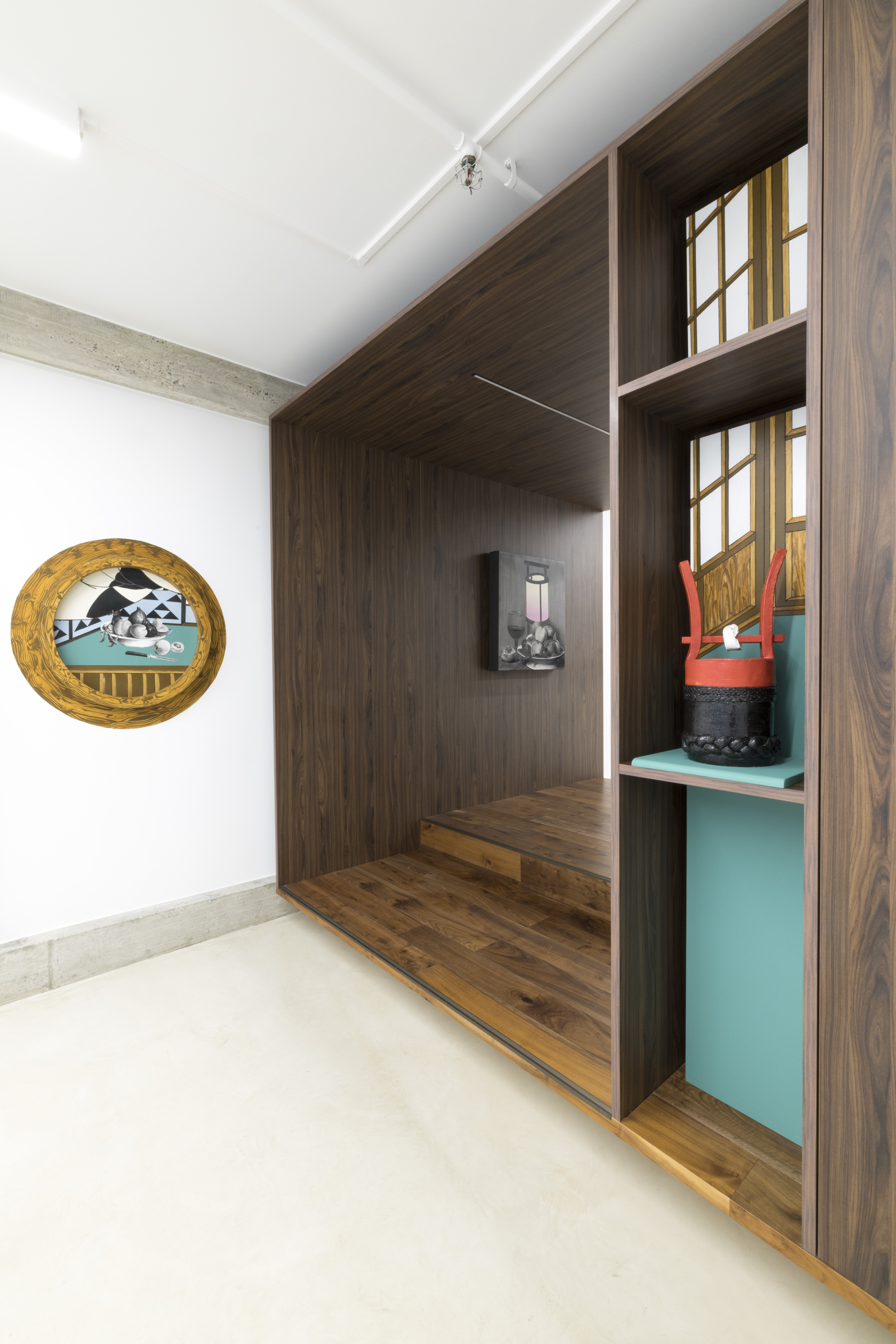
Bryce Delplanque generously offers us a close-up view. A precise and ingenious gaze through a peephole , not only of objects, but also of questions specific to painting and the image – surface, depth, subject, illusion, reproducibility and temporality. In a long Sunday reverie, he literally gives depth to «simple» objects, to those «shy» or silent lives that we have too long disregarded. In his own words, this series of paintings – for him an inexhaustible source of recombination and pleasure – will probably accompany him for a long time, a life of Sundays.
Carin Klonowski
1.Henri Fantin-Latour (1836-1904), peintre et graveur français célèbre (à contrecoeur) pour ses natures mortes.
2.WAJCMAN, Gérard, Ni nature, ni morte, éditions Nous, Caen, 2022, p.33.
3.Utagawa Kuniyoshi (1798-1861), grand maître de l’estampe japonaise, à l’influence internationale (Claude Monet, contemporain de Kuniyoshi, collectionnera ses estampes).
4.Voir LEE, Julian Jin, The origin and the development of japanese Landscape Prints, Washington University, 1977, cité par Bryce Delplanque dans son mémoire de fin d’études, consacré à l’étude d’estampes japonaises de l’ère Edo, 2019.
5.« L’estampe, en tant que procédé mécanique et sériel, peut parfois engendrer des bavures, des décalages ou d’autres erreurs imprévues. Ces petites imperfections techniques me passionnent […]. » in « Meta - Hommages, pastiches et citations » entretien entre Bryce Delplanque et Oriane Castel, Art Critique, Publié le 4 décembre 2024 à 9h00min
6.Le flat design, ou design plat, est un style graphique minimaliste utilisé dans la conception d’interfaces utilisateurs. Il est devenu très présent dans les interfaces web et mobile ces dernières années.
7.WAJCMAN, op. cit., p.33-34.
8.Peephole with Apricots, 2025, dernière peinture en date de cette série, réalisée en tondeau.